
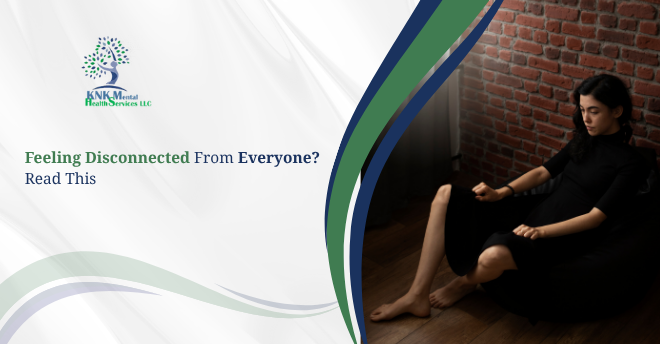
You are engaged in a conversation and then boom: You notice that you have not literally listened to one word. You are nodding, maybe even replying, but far away. Or perhaps you attend an event full of people who love you, and the drive home is a million miles lonelier than before you arrived.
The gap between being in the vicinity of people and feeling connected to them is one of the loneliest places there is. Which a great many are now living quietly in, without really knowing why.
If this sounds like you, then this is essential reading.
It Is Not the Same as Just Being Lonely
To the average mind, loneliness is pictured as an image of a person who has no one around. However, what many adults do experience is a different story. On paper, you have a full life: a job, a partner, friends, and family – all of it available to you; yet somehow you still feel like you’re stuck behind glass watching the rest of the world interact in ways that seem just out of reach.
It is less about the number of people in your life and more about the quality of contact. You can sit at a dinner table and feel invisible. You can have a long phone call and hang up feeling emptier than before. The form of connection is there. The feeling of it is not.
Some of the ways people describe it:
- Like you are performing a version of yourself rather than actually being present
- Like conversations stay surface-level no matter how hard you try
- Like nobody in your life really knows what is going on inside you
- Like closeness is something other people have figured out and you missed the memo
- Like you pull away from people even when you actually want them around
None of that makes you cold or antisocial. It usually means something got in the way, and it is worth figuring out what.
What Gets in the Way
Disconnection does not come out of nowhere. There is almost always something underneath it. Sometimes it has been building for years. Sometimes something specific knocked it loose. Often it is both.
Depression Does More Than Make You Sad
Usually, when people think of depression, they imagine crying or not being able to get out of bed. Yet many adults with depression talk about something more indelible and difficult to speculate. Things that once held significance become less vibrant. It is as if there are people whose signals exist at a frequency you cannot quite tune into. You trudge through day after day, you reply when given the stimulus, but you are at a distance from your life.
And that emotional flatness is really just depression doing its thing. It dims the signal. Connection is exertion in a way that it has never been before, and after some time, you stop struggling for it.
Anxiety Keeps You in Your Own Head
When anxious in social situations, your attention divides. Some of yourself is in the conversation. The other half is keeping an eye on yourself: how you come off, if that landed poorly, if you are doing too much or not enough. That internal running narrative makes it nearly impossible to be present with another human.
You can leave an interaction and think, well that went okay-ish. But in reality, you did not really attend it. And the other person never really got to know you. That pattern of operating over time quietly erodes your belief that connection is available to you.
Old Wounds That Never Fully Healed
The nervous system learns to protect itself when people grow up where closeness is met with unpredictability, criticism, or harm. The idea that being close to someone seems risky in a way that is difficult, if not impossible, to explain logically. You may really want to connect, but do little things that keep people at a distance: canceling plans, shutting down deeper topics, and shrugging off concern when offered.
That is not a character defect. It is a survival mechanism that served you well at some point, but has not managed to hear that things have changed.
Big Life Changes Leave You Untethered
A move, a breakup, a job loss, a death, becoming a parent, a child leaving home. Any of these can quietly dismantle the social world you had built around yourself. The routines that put you in contact with people disappear. The relationships that used to be easy require effort they did not used to. And the new life has not yet grown its own roots.
In that in-between stretch, feeling disconnected is almost inevitable. That does not make it easier. But it does help to know it is not permanent.
Why It Tends to Get Worse on Its Own
The tricky thing about disconnection is that it tends to feed itself. When you feel far from people, you pull back. When you pull back, you lose the small daily interactions that keep relationships feeling alive. When those fade, the distance feels even larger, and reaching out feels even more daunting than it did before.
There is also what happens to the story you tell yourself. After long enough, the disconnection stops feeling like a phase you are going through and starts feeling like evidence about who you are. You start to believe things like:
- I am just not someone who connects easily with people
- People do not really want to hear what is actually going on with me
- I always say the wrong thing or come across wrong
- It is easier to just keep things light with everyone
Those beliefs feel like observations. They are not. They are conclusions drawn from a hard stretch of life, and they tend to harden into habits that keep the disconnection going long after the original cause has passed.
Beyond the emotional toll, chronic isolation also takes a physical one. Ongoing loneliness is linked to poor sleep, a weakened immune system, higher levels of cortisol, and over time, significantly worse health outcomes. The body and the mind do not separate these things neatly.
When It Is More Than Just a Rough Patch
At some point or another, all of us experience periods of feeling slightly out of phase with our surroundings. Life gets busy, friendships fade away, seasons change. This is a common thing, and it generally resolves itself.
However, that said, you have indicative data that suggests but your situation has passed the growth crisis stage and now requires genuine action:
- This is not just a rough few days; it has been weeks or months and months…
- You have stopped engaging with people or activities with which you once found real joy
- You don’t feel anything in most of your interactions, not just some
- You are masking, overworking, binge eating, drinking powder juice drinks, or scrolling endlessly to avoid that feeling
- Has thought that the world would be better off without you or that you are a burden
- It is impacting your work, home life, and not just your mood but how you function.
If any of that rings a bell, it is not an indication for you to grind even harder on your own. Or that’s a call to reach out to someone.
What Actually Helps
There is no silver bullet, and anyone who tells you otherwise is selling something. Now some things really do help, both from yourself and from others.
Say It Out Loud to Someone
Many have never even told so much to anyone who is disconnected. They may beat around the bush about it or make a joke out of it, but never sit someone down and say, I feel really alone and do not know why.
That conversation is uncomfortable. It’s also typically when things start to change. Not that the other person is fixing anything, just the fact of saying to someone – here I am – where you are, is a little act of courageous connection.
Stop Waiting Until You Feel Ready
Disconnection creates a catch-22 where you tell yourself you will reach out once you feel more like yourself. But the feeling like yourself often comes from reaching out, not before it. You will not feel ready. Reach out anyway. Text someone back. Show up even when you do not feel like it. Start small.
Small looks like:
- Being honest when someone asks how you are, even just a little
- Following up with one person you have been meaning to contact
- Putting your phone away during a meal and just being in the room
- Saying yes to something low-stakes that you would normally skip
Address What Is Actually Driving It
If it stems from depression, anxiety, or something related to an old trauma, all the socialisation tips in the world won’t go that far. The engine underneath needs attention. That usually means getting that professionally, one way or another – therapy, medication, or both – and it’s worth an honest look at what you’re dealing with.
What Therapy Actually Does for Disconnection
A lot of people picture therapy as talking about your childhood for years. Some of it is that. But a lot of it is more practical than people expect.
For disconnection specifically, a few things tend to happen in therapy that are hard to replicate elsewhere:
- You get to practice being honest with someone without managing how they feel about it. That is rarer than it sounds.
- You start to see the patterns clearly – the ways you protect yourself that also keep people out, and you begin to have more choice about them.
- If trauma is part of the picture, you work through the nervous system responses that make closeness feel dangerous even when it is not.
- You rebuild a different relationship with yourself – which tends to make letting other people in feel less threatening.
One More Thing Worth Saying
There is something about that feeling of being disconnected, your brain trying to tell you reaching out would not help, and that you are too far gone, no one will understand, and it is better just to cope along with silence. That voice is convincing. It is also not reliable.
People emerge from long solitude. They reconstruct relationships that they thought were beyond repair. Occasionally, with lag time and in slow motion, they discern what is blocking them and practice how to travel through space differently. This is not the road most traveled, nor the road taken this or any night but it will be taken in time.
The only thing that matters is that this is bothering you, and that you are still conscious of the gap, and still want something else.
KNK Mental Health Services Is Here When You Are Ready
At KNK Mental Health Services in Laurel, Maryland, we assist individuals who are carrying things they have carried long enough alone.
Everyone deserves mental health care that feels like a human-to-human connection, and that is what we are here for.
